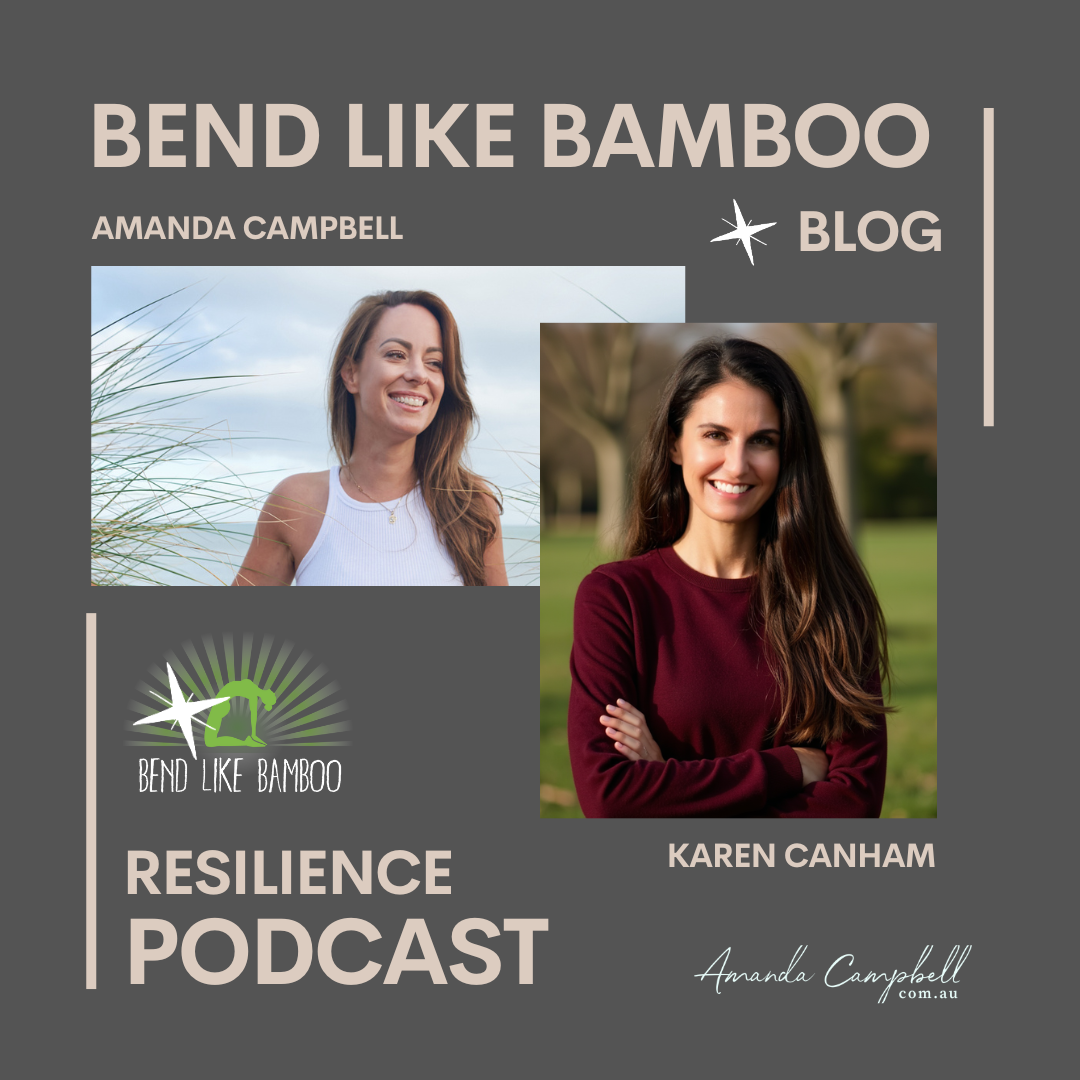
Why Your Calm Is Contagious: The Ripple Effect of Nervous System Regulation | with Karen Canham: Ep 61
Welcome to The Bend Like Bamboo Resilience Show
We discover that our greatest challenges often become our greatest strengths.
Each month, I sit down with remarkable leaders who've transformed adversity into triumph, sharing their inspiring journeys of resilience and renewal. Together, we explore the mindset shifts, practical strategies, and breakthrough moments that turned their setbacks into comebacks.
What you'll discover:
Real stories of people who've learned to bend without breaking, actionable tools to transform stress into strength, and evidence that when we change our story, we change what's possible for our health, relationships, and future.
Like bamboo, we're designed to be flexible.
When we embrace this truth, we don't just survive life's storms - we use them to grow stronger, wiser, and more resilient than ever before.
Join me as we explore how flexibility builds unshakeable resilience.
The Corporate Leader Who Discovered That Success Wasn't About the Title
Karen Canham had the title. She had climbed the Fortune 50 ladder. She was leading teams, making decisions, achieving the markers of success that society told her mattered.
But something wasn't right.
"I think it hit me a few times through my life where I was like, what am I doing? This isn't really me," Karen reflects. "But I didn't necessarily listen and continued to push through. A lot of that was chasing this title and these corporations."
For years, Karen taught yoga on the side while working in corporate leadership. She loved the coaching and leadership aspects of her role, but the corporate structure—the red tape, the inability to fully show up as herself, the conflict between caring deeply about people and the reality that "this is a business"—kept gnawing at her.
Leaders kept reassuring her: "That's okay that you don't love the industry necessarily, but you love leadership, and you love helping people, and that's enough."
But it wasn't enough.
"I couldn't fully express myself in the way that I wanted to," Karen explains. "I've always been a person who, if I saw injustice, I was going to stand up for that other person. I really care about people and humanity in this world, and that can come into conflict sometimes."
When she moved to Florida two and a half years ago, she tried consulting for a startup she'd previously worked with. It lasted a month.
"I was just like, what am I doing?" Karen recalls. "That was the time I knew for sure that it was time for me to really focus on the coaching business and really utilise the things that I saw make a huge difference in my life and with other people around me."
Today, as a Nervous System and Somatic Coach, Karen helps professionals and entrepreneurs move from survival mode into grounded, sustainable leadership—not by achieving more titles, but by learning to regulate from within.
The Eating Disorder That Taught Karen About Disconnection

Karen Canham | Nervous System and Somatic Coach
Behind Karen's corporate success story was a deeper struggle that began much earlier.
From age 10, Karen lived with an eating disorder. It became severe at 16. But she didn't get the treatment she truly needed until her late 20s, early 30s.
"I had to use a feelings wheel," Karen shares vulnerably. "In the middle, we'd start with the basic feelings of sad, anger, and then it branches out to get deeper—like, what that sadness is. Is it depression? Is it loneliness?"
For almost a year, Karen used that wheel to access what her core emotions were, and then to build down from there to discover what was really underneath.
"After you're able to access those emotions, then you can start to feel into the body," Karen explains. "That was my experience, and that's my experience with most of my clients."
This is where most people get it wrong about meditation, mindfulness, and nervous system work.
"People will say, oh, well, I suck at meditation," Karen says. "Well, yeah, you can't just hop right into it. There's a process that you need to go through to be able to build and access and titrate and start building that capacity in your system."
The eating disorder taught Karen something fundamental: When we disconnect from our bodies, we disconnect from ourselves. And when we disconnect from ourselves, we can't truly lead—not others, and certainly not ourselves.
Coping vs. Regulation: Why Most Leaders Are Just Surviving
One of the most powerful distinctions Karen makes in her work is between coping and true nervous system regulation.
"The biggest thing for me within regulation of the nervous system is digging into these patterns that are shaping the way that we're behaving," Karen explains.
Sure, we can use neural tools in the moment to help us regulate. We can use somatic practices to get into our bodies and have awareness of what's happening. Our bodies tell us first, before our minds do.
But the deeper work—the transformative work—is getting into those patterns.
"If we become more aware of what those patterns are, and not just the awareness, but how do I shift those patterns, and how are those patterns affecting other people? How are those patterns affecting how I show up in my company, how I show up in my role, how I communicate with my team?"
This is the piece that takes the most work. The most capacity. It's uncomfortable.
"But it really is the basis of what leadership is," Karen says. "For a long time, leadership to me used to be a title, that I got to tell other people what to do, that I knew enough to be able to tell other people what to do. But ultimately, the more I progressed in my career, the more it was finding out that, no, ultimately, leadership is you being regulated."
And this goes back to those patterns—how are we showing up, and how does that come off to other people, and how do we then communicate?
"The work never ends," Karen acknowledges. "There's always going to be stuff there to work on. But it also doesn't have to feel really heavy. I think a lot of people think that it needs to, and it really doesn't have to be that way."
The Body Leads Before the Mind Follows
Karen teaches something I know intimately from my own recovery from paralysis: The body leads before the mind follows.
When I was paralysed at 29, my body had to heal before my mind could fully believe it was possible. But vice versa as well—I had to believe it before more healing would come.
This is the dance of healing. The interplay of soma and psyche.
For people stuck in survival mode—their nervous systems constantly hypervigilant, always firefighting at work—the signs are showing up in the body first.
Karen asks us to check in: Is there tightness in my chest? Is my breath shallow or deep? Am I breathing in my chest or my belly? Do I have tightness in my shoulders? In my hips?
These aren't just physical sensations. They're your body's language, trying to tell you something your mind hasn't admitted yet.
"This is all part of the healing," I shared with Karen, "because we don't want to be aware of what's around us and our bodies when we're recovering from trauma and stress."
So the practice of bringing awareness back to the body, back to the environment, back to the present moment—this isn't complicated. It can be journaling, meditation, walking, movement. All these pillars of health that we take for granted.
"It's really just bringing all of that into your awareness as a daily practice every day," I explained. "So that when the storm really does come, you can then bend, and you've got the tools because you've been doing it every day."
Karen's response was perfect: "And if you weren't, then you wouldn't bend. You would snap."
Why Slowing Down Isn't Weakness—It's Your Nervous System Strategy
Here's where most people get stuck. They hear "slow down" and immediately think: "That's great, but I don't have time to slow down. I'm a mother, I work full-time, I have a husband, I have responsibilities."
Karen gets it. That's real life.
"It's not necessarily that we have to do less," Karen clarifies. "It's that we need to take the time to pause, and it can be for a very brief period of time."
This slowing down piece is just taking the time to start to check in with the body.
What am I feeling? Is there tightness in my chest? Is my breath shallow? Is it deep? Do I have tightness in my shoulders? Is there tightness in my hips?
Notice what's in your room right now. How bright your lights feel. The tactile sense of your desk under your hands.
"Those little things feel really silly and stupid, but that is really what starts to create the safety in your body," Karen explains. "That tells your body: Oh, I'm present. I'm safe here in this present moment."
And that's the first step to start to build that capacity in your nervous system.
Once you do those little things, they become automatic. You're more aware of what's happening in the body, all those sensations, your environment. Then you have more capacity. Then you can start to go deeper into those patterns.
This is why slowing down is strategic, not self-indulgent.
When you're regulated, you have:
Clarity - You can see the situation as it is, not through the lens of your activated nervous system
Creativity - Your prefrontal cortex comes back online; you can think strategically instead of reactively
Power - You respond from a place of choice rather than compulsion
When you're dysregulated, you're operating from survival mode. And survival mode doesn't do innovation. It doesn't do nuance. It does react, protect, defend.
Self-Leadership: Learning to Meet Your Own Needs
"To be able to be a good leader, you need to be able to lead yourself," Karen teaches.
She meets with a lot of clients—and this was her own journey too—who don't know how to meet their own needs. Often this comes from childhood trauma, from needs not being met.
"As an adult, you don't know how to meet your needs, and so part of this work is learning how to reparent yourself or meet those needs."
This is nervous system regulation in practice.
And Karen is clear about this: The goal is not to be regulated all the time.
"It is normal for us to be in these other places," she explains. "It's normal for us to be in a heightened state. It's normal for us to be more in this malaise, kind of shutdown state. It's when it becomes chronic that it becomes the issue."
Being able to recognise those states and self-lead—that's where the power is.
Karen's Nervous System Framework: Neural Tools, Somatics, and Parts Work
Karen's approach is comprehensive, working at multiple levels to create lasting change:
1. Neural Tools
These help in the moment to get into a more regulated state. When you're feeling anxious or your energy is low, you can use a neural tool to bring yourself more into the center—into what Karen calls "the green zone."
2. Somatics
This is about getting into the body and having awareness of what's happening. Learning to feel sensations, to notice where emotions live in your body, to understand your body's unique language.
"Our body will tell us first before our mind does," Karen reminds us.
3. Parts Work Therapy
This is the deeper work—looking at old patterns. When did they develop? Why did they develop? Why are they still here? What purpose are they serving now?
With parts work, you start to understand not just your own internal system, but other people's parts too. You can "map other people's systems," as Karen calls it—understand other people better, attune to them.
"That really helps with the communication piece as well," Karen explains.
The Ripple Effect: How Your Calm Changes Everything
This is where Karen's teaching becomes truly transformative—and it's something I asked her to paint a picture of for my listeners.
When one person regulates their nervous system, it literally changes a room, a team, a family system.
How does calm become contagious?
"The ripple effect is what my experience was, and what my clients' experiences are," Karen shares. "They'll immediately tell me within a couple weeks, or 3 weeks—usually that 2-3 week period—they'll say, 'My husband is commenting on changes.' Usually the husband was really sceptical of me signing up for this, and then it's like, oh, he's noticing changes in me. A couple months in, it's this drastic change."
It's progressive.
The work of taking those seconds every hour, using those practices as you load them onto another thing you're doing—that's the beginning. That brings safety to your system.
And when you operate from that place of safety—what we call the ventral vagal state—that's when you have the calmness, the clarity, the power.
Your system is screaming to you: "Hey, I'm here. I'm communicating to you. Are you listening to me?"
When you take even a little bit of time and tune in—"Yeah, I am tuning into you. I feel you. I see you"—that's when the deeper work can happen.
Co-Regulation: The Science of Contagious Calm
Here's the neuroscience behind the ripple effect: It's called co-regulation.
"We start to regulate other people's systems based on the regulation of our system," Karen explains.
Think about it:
If you're a mother and you react to your child having a tantrum, that usually doesn't help. It usually makes things worse.
Or with a dog—when we're reactive to that dog, the dog is going to respond from a dysregulated place.
But the more that we can respond from a regulated place, the person (or animal) responding to us is going to respond from that regulated place too. And then that regulation just grows.
This applies in your family. In your team at work. In every interaction you have.
Karen and I both see this constantly: When leaders regulate themselves, their teams perform better. When parents regulate themselves, their children are calmer. When one person in a relationship does this work, the entire relationship shifts.
You don't have to fix everyone around you. You just have to do your own work.
The One Practice That Changes Everything: 10 Seconds Every Hour
When I asked Karen for one practice someone could start today to begin creating that ripple effect, her answer was beautifully simple:
"Take 10 seconds every hour."
You don't have to make it a ritual. You don't have to time it and write it down and set alarms. Just have it in your mind: Okay, 10 seconds every hour.
In those 10 seconds:
Option 1: Feel your desk. The tactile sensation grounds you in the present moment.
Option 2: Orient around you. Name what you see in your room. Name colours. Or pick one specific object and get really curious about it.
Option 3: Focus on your breath. Just notice it. Not changing it, just being with it.
Option 4: Body scan. Do a quick feel-through of your body from head to toe.
"I know that was a lot of options," Karen laughs. "But that's a starting point of just taking 10 seconds every hour just to check in with yourself."
I loved this because I do something similar with my clients—morning and evening journaling and meditation to set their state and remember what we're working on. I give them wristbands that say "I'm enough" as a prop to remind them throughout the day.
But Karen's point is crucial: For high achievers, it's not about doing more.
"Even though this work is work, it's not about doing more," she emphasises. "It really is about just listening in."
You can do it when you get up to go to the bathroom. Walk and feel your feet on the ground. Notice what's around you.
It doesn't have to be another added thing to your plate.
Building Capacity: Why the Small Things Matter
Here's what happens when you do these small practices consistently:
Week 1-2: You start to notice. Oh, my shoulders are tight. My breath is shallow. I'm clenching my jaw.
Week 3-4: The practices start to become automatic. You catch yourself checking in without having to remind yourself.
Month 2-3: You start to build capacity. When you feel sadness, you can feel it automatically. You feel exactly where you feel it—and it's usually in the same spot of your body most of the time.
Ongoing: You're able to operate from the "green zone" more often instead of being in that heightened state where you're anxious, pushing through, reactive. Or in that shutdown state where you're walking away from situations or not communicating.
This is how you build a nervous system that can bend without breaking.
This is how bamboo survives storms.
My Resilience Formula: Why This All Connects
As Karen and I talked, I shared my resilience formula:
Anchor - Letting Go + Flexibility = Resilience
The anchor is returning to self and regulating your nervous system. But we have to become aware of why we're split off, any stuck emotions there. (I use kinesiology for that.)
Once we can return to self, we can not only regulate our nervous system and reduce stress levels, but we can open our hearts again.
Then comes letting go of redundant ideas, thoughts, beliefs, and stories we've accumulated across our whole lifetime.
That leads to the flexible mindset.
Karen loved this visual: "I really love that image of the tree. When we're not flowing, there's stuckness, and things break off and become damaged."
We're both teaching the same truth from different angles:
You can't force your way to healing. You can't just push harder. You have to learn to bend like bamboo—to be flexible, to listen to your body, to work with your system rather than against it.

What This Means for Your Life
Whether you're a CEO dealing with burnout, a parent trying to stay calm in the chaos, or someone managing a chronic health condition—Karen's work offers a roadmap.
For the THRIVE audience (leaders and executives):
Your regulation impacts your entire team. When you do this work, you don't just perform better—you create psychological safety for everyone around you. You make better decisions from a place of clarity rather than reactivity. You model what sustainable leadership actually looks like.
For the HEAL audience (chronic conditions and autoimmune):
Your nervous system state directly impacts your immune function, your inflammation levels, your pain, your energy. When you're chronically dysregulated, your body stays in fight-or-flight, which means it's not in heal-and-repair. Regulation isn't just about feeling better mentally—it's about creating the conditions for your body to heal.
For everyone:
The ripple effect is real. You doing this work impacts your children, your partner, your team, your community. You don't have to fix everyone. You just have to do your own work.
And the beautiful part? It doesn't have to be complicated. It doesn't have to be another thing on your to-do list.
10 seconds every hour.
Feeling your feet on the ground as you walk to the bathroom.
Noticing your breath as you wait for your coffee to brew.
These small moments of presence, repeated consistently, build a nervous system that can handle whatever life throws at you.
The Invitation: From Survival to Sustainable Leadership
Karen's journey from Fortune 50 leader to nervous system coach mirrors what so many of us are experiencing:
The old model of success—pushing through, chasing titles, operating from constant activation—is making us sick.
The new model—leading from regulation, responding rather than reacting, building capacity in our systems—is what sustainable success actually looks like.
"Leadership is you being regulated," Karen teaches. "And that goes back to these patterns—how are we showing up, and how does that come off to other people, and how do we then communicate."
The work never ends. There's always going to be more to explore, more patterns to understand, more capacity to build.
But it doesn't have to feel heavy.
It can feel like 10 seconds of presence. Like feeling the texture of your desk. Like noticing the color of the sky.
Small moments, repeated consistently, that tell your nervous system: You're safe. You're present. You're here.
And from that place of safety, everything changes.
Your clarity improves. Your creativity comes back online. Your power—real power, not the borrowed power of a title—becomes available to you.
And it ripples out.
To your partner. Your children. Your team. Everyone you encounter.
Because calm is contagious.
And your regulation creates space for others to regulate too.
Connect with Karen Canham
Website: karenandwellness.com
Karen offers one-on-one coaching and group programs for professionals and entrepreneurs who want to move from survival mode into grounded, sustainable leadership. Her work combines nervous system regulation, somatic practices, and parts work therapy to create transformative, lasting change.
If you're a leader who knows something needs to shift, if you're tired of pushing through and ready to lead from a regulated place, Karen's work might be exactly what you need.


WHO THIS IS FOR:
✓ CEOs and executives experiencing stress or burnout
✓ People with autoimmune conditions seeking healing and transformation
✓ Leaders wanting to build sustainable high performance
✓ Leaders navigating chronic health challenges while maintaining demanding careers
WORK WITH AMANDA:
HEAL Program (Autoimmune & Stress):https://www.bendlikebamboo.com/heal-bamboo-method
THRIVE Program (Executive Burnout): https://www.bendlikebamboo.com/thrive-bamboo-method
Foundations Program (The Bamboo Course): https://www.bendlikebamboo.com/bamboo-foundations
Free Clarity Call: https://www.bendlikebamboo.com/service-booking-clarity-call
Free Resilience Toolkit: https://www.bendlikebamboo.com/thrive-subscribe
Join our Facebook Group: https://www.facebook.com/groups/680729421231191
The Podcast on iTunes https://podcasts.apple.com/au/podcast/the-bend-like-bamboo-resilience-podcast/id1536494209
The Podcast on Spotify https://open.spotify.com/show/3bu07WcTq6VDbzTlK197zw
YouTube https://www.youtube.com/@BendLikeBamboo
CONNECT:
Website: bendlikebamboo.com
Instagram: @bendlikebamboo
Facebook: @bendlikebamboo
LinkedIn: amanda-campbell-resilience-coach