

Welcome to The Bend Like Bamboo Resilience Show
We discover that our greatest challenges often become our greatest strengths.
Each month, I sit down with remarkable leaders who've transformed adversity into triumph, sharing their inspiring journeys of resilience and renewal. Together, we explore the mindset shifts, practical strategies, and breakthrough moments that turned their setbacks into comebacks.
What you'll discover:
Real stories of people who've learned to bend without breaking, actionable tools to transform stress into strength, and evidence that when we change our story, we change what's possible for our health, relationships, and future.
Like bamboo, we're designed to be flexible.
When we embrace this truth, we don't just survive life's storms - we use them to grow stronger, wiser, and more resilient than ever before.
Join me as we explore how flexibility builds unshakeable resilience.
Some conversations arrive at exactly the right moment.
This one is one of them.
I recently sat down with Karen Humphries — a Mental Health Counsellor, Advanced Kinesiologist, Hypnotherapist, Meditation Teacher, Trauma-Informed Coach, published author, and Breast Cancer Conqueror. Karen works from Gippsland, Victoria, through her practice Blooming From Within, and brings a lens to her work that only comes from standing on both sides of the clinic table.
Like me, Karen's professional work and her lived experience have become deeply entwined.
When Karen became the cancer patient, she experienced something she had never fully understood from the practitioner side of the table. In her own beautiful words — "becoming the patient changed the therapist."
And while everyone quite rightly asked her how she was coping, Karen began watching the people standing beside her. Her husband. Her daughter. Her beautiful village. All of them trying to remain strong, useful and positive — while quietly carrying fear, uncertainty, and their own nervous system responses.
That observation became the question that would shape her second book.
Who is holding the helper?
Her brand new book, Holding The Helper — Supporting the Cancer Caregiver, launched on 18 October 2026 at Moe Racing Club's Pink Ladies Day, immediately following National Carers Week.
This blog is a reflection on our conversation — one I believe every caregiver, every practitioner, and every woman navigating her own health Experience needs to read.
From Industrial Chemist to Kinesiologist — Karen's Path to Healing
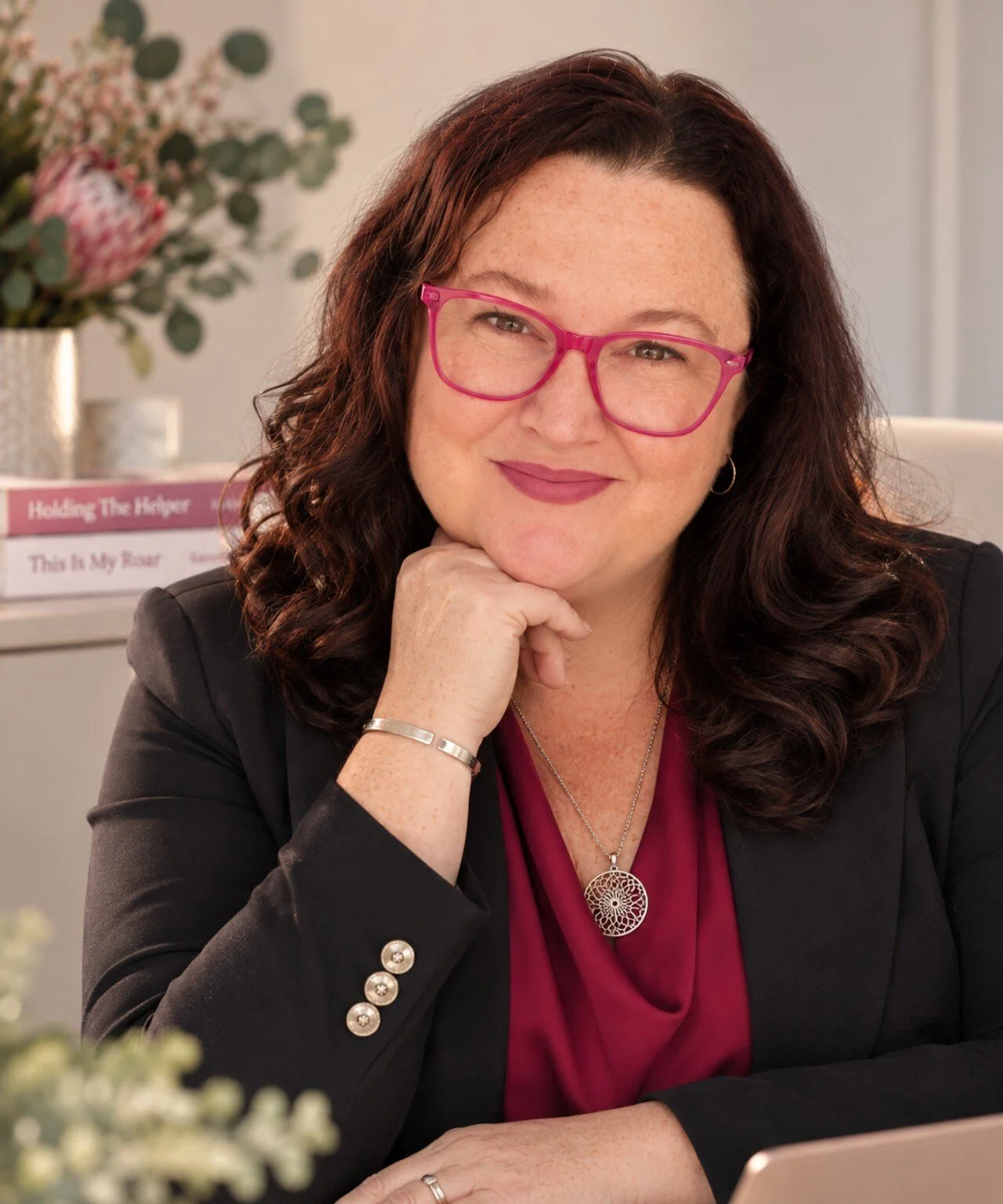
Karen's story begins somewhere unexpected.
She didn't start in the healing world. She began her career as an industrial chemist and environmental scientist, working at the Environment Protection Authority as a prosecution officer for a decade.
"Super stressful," she told me.
Crohn's disease ran in Karen's family, and she was diagnosed at 24. Western medicine didn't do her any favours — she never responded well to the medications, and eventually developed complications with her liver.
After leaving the EPA, Karen moved into consulting, which took her back up to Melbourne. The move opened a door for her to study, and she dabbled in massage, shiatsu, and wellness coaching.
But none of it was enough. Something was still missing.
It wasn't until she experienced several miscarriages and her Crohn's spiralled out of control that she stumbled across an introductory evening for kinesiology — pulled there by a friend who refused to go alone.
The moment she got onto the table, everything clicked.
"When she started talking about piezoelectric circuits and salt exchange at the neural level, I thought — oh, this chick's talking my jam. It's just got a bit of woo-woo to it."
Her scientific brain and her intuitive knowing finally met in the same room.
Karen went on to complete diplomas in neurotraining and kinesiology, continuing to study every advanced subject she could get her hands on. She trained with Jacque Mooney in the LEAP series, dabbled in PKP, and over 20 years has built a practice that integrates:
Kinesiology
Hypnotherapy
Meditation
Somatic breathwork
Resource therapy
Trauma-informed counselling
"I feel like with more than 20 years' experience now," she said, "you find that each practitioner does kinesiology their own way. The structure is the same — but the lens, the layering, the counselling skills on top, that's what deepens the conscious awareness in the client, so they can make rapid changes."
What struck me most listening to Karen is that she doesn't position herself as the person who fixes you. She positions herself as the one who helps you understand your own body again.
"My job's not to fix you," she said. "My job's to identify what is the stress story today that's driving the symptom you wanted resolved, and what do you need to be doing differently when you go home for the session to remain in place."
That one line captures the entire philosophy of her work
The Beauty of Looking at the Person as a Whole
Karen and I share a deep belief that healing cannot be delivered by one modality alone.
"What bends Western medicine's mind," she said, "is that doctors look at a thousand people with breast cancer and find a treatment that works for the masses. But it doesn't factor in what was the story 10, 20 years before the cancer that may have set the wheels in motion."
She paused, then said:
"We look at the body as a whole. We look at a person as a whole. Not just as their pain, not just as their headaches."
For both of us, this is why kinesiology continues to be the modality we come home to. It works with the structural, biochemical, emotional, and energetic layers of a person — all at once.
Karen described her signature opening question with clients beautifully:
"What would it be like if you were willing to learn to feel safe and calm again?"
That is the moment the work begins.
Because as Karen put it — "if you're not learning what those signals of not feeling safe and calm feel like, how do you make change without being in a defensive space? You can't do it."
The Meerkat, The Mountain Lion, and the Nervous System
One of Karen's most memorable images from our conversation was her description of what happens when the nervous system is stuck in survival mode.
"When you're in meerkat mode, you're in survival. Your vision of what your reality is comes down to meerkat goggles."
In her clinic, Karen helps clients soften that meerkat — gently, step by step. Bringing them back to the breath. Back into the body. Back to the signals they've learned to override.
Because when we override our body's signals for too long, she said, "the meerkat becomes a permanent resident in your nervous system, always looking for the mountain lion in the fridge."
That line stayed with me.
Karen's work gives women permission to recognise their own safety signals — and to finally listen to them.
Do You Believe Physical Symptoms Are Our Body Talking to Us?
I asked Karen this directly during our conversation.
Her answer was unforgettable:
"I think that's your body's last resort of bitch-slapping you to say — please, will you pay attention?"
For both of us, this is the heart of why we do this work.
The chronic fatigue. The autoimmune flares. The headaches that come at the end of every quarter. The gut issues before the big launch.
These aren't annoyances to push through.
They are the body's final attempt to be heard before something louder arrives.
Becoming the Patient — Karen's Breast Cancer Experience
Karen's cancer Experience didn't begin with a lump. It began with a whisper.
Travelling with her family through Western Australia, Karen was in the Perth Botanical Gardens meditating when she felt Spirit step in and tell her clearly — "something's not right, and you need to get it checked. Don't delay this."
She describes it as feeling like her mum was sitting next to her, the warmth of a hand. Karen was diagnosed on the exact anniversary of her mother's passing five years earlier.
The experience that followed was deeply traumatic. During a biopsy, the driver got stuck in her for over an hour. She was traumatised, bleeding, and left waiting through faffing and multiple missed samples.
What Karen did next moved me so deeply.
She went home and wrote a 5-page gap-analysis audit report to Breast Screen Victoria — framed as if she were an auditor, drawing on her EPA background. From booking in through ongoing consent training and trauma-informed care for staff, her complaint was so thorough that Breast Screen Victoria adopted her recommendations nationally.
"Warrior woman stood up to the plate," she said. "She's made sure that will never happen to someone else again."
That is Karen Humphries.

The Drastic Action That Saved Her Life
Spirit kept telling Karen — "you have to take drastic action. They won't find it all."
Despite the surgeon preferring a less aggressive approach, Karen trusted her gut. She chose a mastectomy and reconstruction.
The original imaging showed 4cm of DCIS. The MRI then showed 12cm. The final pathology, after surgery, showed 18cm of DCIS and a Grade 3 lobular carcinoma close to lymph.
Her surgeon turned to her afterwards and said:
"Don't you ever not trust your gut. We would have had to go back three or four times, and we still wouldn't have got it all."
Karen then endured chemotherapy, hormone blocking (which made her suicidal and had to be stopped after two months), and immunosuppressant therapy — all through COVID lockdown.
"I was one of those patients who challenged my doctors," she laughed. "And I advocated for myself very strongly."
She started mental health support from the very beginning, not waiting until after discharge like most patients do.
"By then," she said, "it's too late. PTSD's kicked in, and you've got a battle ahead of you."
Her message to anyone navigating a diagnosis is this:
Advocate for yourself. Doctors work for you.
Ask questions. Keep asking until you feel safe with the answer.
Find practitioners who adapt to you — not the other way around.
Begin mental health support early. Not after. Right from the beginning.
Who Is Holding the Helper?
While Karen was navigating treatment, something began to catch her attention.
Everyone was asking her how she was doing — and quite rightly so.
But no one was asking the people standing beside her.
Her husband. Her daughter, who was cataloguing every cough and every little change in her mother's body. Her beautiful friends who wanted to help but didn't quite know how.
"My daughter's cataloguing didn't make her feel safe," Karen said. "And I had to learn how to receive all of the love I had ever given out — all at once."
Karen began to see the carer's experience with new eyes:
The tight shoulders
The shallow breathing
The unshed tears
The deer-in-the-headlights eyes
The hypervigilance that becomes a permanent state
"The patient has something to do," she said. "They go to the appointments, the treatments, the surgeries. They're doing something. The carer is just watching the whole time — and no one is reaching out to them."
That was the moment the book began to form in her.
A download arrived three days after Cassandra Rendell, CEO of Moe Racing Club, invited her to keynote at the hospital's Pink Ladies Day fundraising event.
Within those three days — Karen had the outline for Holding The Helper
Why This Book Is Not Just Another Book
Karen could have written a book that someone reads once and puts back on the shelf.
She chose to write a book that works with the reader.
Holding The Helper is structured across the four stages of the cancer experience:
Before Diagnosis — when something feels off
Diagnosis — processing the shock
Treatment — the long haul
Recovery — what comes after
Each stage includes:
Therapeutic reflective questions rooted in ACT (Acceptance and Commitment Therapy)
Somatic breathwork practices — small enough to do in the car park outside an oncology appointment
Guided meditations with hypnotic suggestion to bring forward a strong internal resource
Over 3 hours of guided therapeutic meditation, more than 40 somatic practices, and a dedicated practitioner toolkit for kinesiologists, counsellors, hypnotherapists and meditation teachers.
"The book is 9 chapters," she explained. "It breaks down the four stages of the emotions of cancer — the pre-diagnosis, diagnosis, treatment, and recovery. It has therapeutic questions, somatic breathwork activities, and meditations with hypnotic suggestion to support you at a subconscious level."
As a fellow kinesiologist, I understood immediately why this matters so deeply.
Sometimes insight isn't enough. The body needs somewhere to go with what it has been holding.
What the Body Teaches Us About Resilience
Toward the end of our conversation, I asked Karen what her body had taught her about resilience.
Her answer was profound:
"Resilience isn't about being tough. Before cancer, I had the capacity to always push through. I realise now that doesn't serve any working mother at all."
"Resilience is the ability to bend and come back. My body taught me that falling apart is part of a cancer experience — and it's part of menopause too. Don't try and skip the hard bits with a magic quick-fix pill. You migrate through it with rest, self-kindness, and permission that there are days where you just can't do."
"A body that feels safe can recover. It may not recover to what you were before — but there's more consistency now of go, breathe, rest."
She paused and smiled.
"Cancer taught me it's actually more pleasant to slow down. You see more. You take the meerkat goggles off. You experience more."
That is the resilience of bamboo.
Bend. Don't break.
Karen's Final Message
I asked Karen to leave listeners with one message — one thing to carry with them from this conversation.
She didn't hesitate:
"If you're the helper, you deserve to be held too. Your fear is real. Your tiredness is real. Looking after yourself is not selfish — it's what keeps you going."
"Today, if you're listening — put your hand on your chest. Take a long, slow, deep breath. Exhale slowly. That one's just for you."
"You really can choose to change and bloom from within."
— Karen Humphries
Where to Find Karen and Her Work
Karen's new book Holding The Helper — Supporting the Cancer Caregiver is now available.
Website: karenhumphries.net.au
instagram: @changechick
Podcast: I Am Changing — on Spotify
Buy the Book: eBook and print now available via her website
Chapter One: Read free at karenhumphries.net.au/holding-the-helper
If you work with cancer patients, caregivers, or anyone navigating long-term health challenges — Karen's book should be on your shelf. If you ARE a caregiver — this book was written for you.
From My Heart
Our conversation went places I didn't expect — into Spirit, into advocacy, into the trauma of a medical system that still has so much to learn about caregivers, into the deep practitioner knowing that only comes from having walked the path yourself.
For my HEAL community — Karen's story is a reminder that the body always speaks. That slowing down is not failure. That advocating for yourself with your medical team is not optional. And that the softness you build on the other side of a diagnosis is the strongest version of you there is.
For my THRIVE community — Karen's Experience is also one of extraordinary leadership. A high-performer who had to learn how to receive. A woman who used her voice to change a national system. A practitioner who kept building, kept growing, kept writing — through chemo, through COVID lockdown, through menopause, through recovery. This is what sustainable leadership actually looks like.
For anyone who loves someone facing a health challenge — please read this book. Please let the people standing beside you know that they, too, deserve to be held.
With love and gratitude,
Amanda


Ready to build sustainable resilience? Here's how to work with me:
🌿 HEAL – If you're managing autoimmune conditions, chronic stress, or health challenges
Deep-dive 1:1 support with kinesiology and nervous system regulation
→ Learn about HEAL: https://www.bendlikebamboo.com/heal-bamboo-method
🌿THRIVE – If you're a leader, coach, or practitioner experiencing burnout, this intensive 1:1 program is for sustainable leadership without sacrificing your wellbeing
→ Learn about THRIVE: https://www.bendlikebamboo.com/thrive-bamboo-method
🌿 Foundations – Want the complete Bamboo Method at your own pace?
Self-paced digital course teaching all six pillars of resilience
→ Explore Foundations: https://www.bendlikebamboo.com/bamboo-foundations
Not sure which path is yours?
📍 Book a Free Clarity Call with me, and we’ll explore together.
https://www.bendlikebamboo.com/service-booking-clarity-call
Remember: With a flexible mindset, we can adapt, transform our story, and reimagine what's possible.
Free Resources:
The Podcast on iTunes
The Podcast on Spotify
Watch on YouTube
Free Resilience Toolkit
Connect:
Website: bendlikebamboo.com
Instagram: @bendlikebamboo
Facebook: @bendlikebamboo
LinkedIn: amanda-campbell-resilience-coach